
Blog / Automotive Tips

Tips for Driving with Your Dog

Keep your dog attended to at all times.

This means to ensure that they are not alone in a hot car, and their well-being is attended to at all times. Even when the temperature is 70 degrees outside, the inside temperature of the vehicle can reach above 90 degrees inside in just the first 10 minutes, and over 110 in 30 minutes. Please take your best friend with you when leaving the car!

Be sure your dog has proper identification.

Traveling can lead to new, never-been-explored places for your dog! It's important to make sure they have an identification tag that can easily be tracked back to you. It's also a great idea to consider getting a microchip for your dog.

Don't let your dog ride loose in your truck bed. This can be very dangerous as you never know what may happen when you're on the road. If you are involved in an accident, your dog has a high risk of serious injury in the truck bed. Keeping your dog inside the cabin is the safest place for your dog to ride. If you cannot keep them in the cabin, keep a secured kennel in the back of the truck.

Always have extra pet supplies.

From a water bowl and water, to rolls of waste bags, it's important to make sure you'll have everything you'll need to keep your pet happy, healthy and safe when traveling.

Pet accessories can make their ride more comfortable.

There are so many accessories out there designed to keep your pet safe when in the car! These include pet nets to prevent your pet from entering the driver's area or front of the cabin, backseat extenders to increase your seat space for your pet, seat belt leashes and more! Our Speck Nissan parts department can help you find the vehicle accessories you need.

The information provided is for general informational purposes only and does not constitute legal, financial, or professional advice. While we strive to provide accurate and up-to-date information, we make no guarantees regarding the completeness, accuracy, or reliability of the information presented. Any action you take based on the context of this blog is strictly at your own risk. Always consult a qualified professional or specialist for advice specific to your situation. We are not responsible for any losses or damages arising from the use of this blog or its content.
Posted in:

Related Posts

What is Considered Good Gas Mileage?

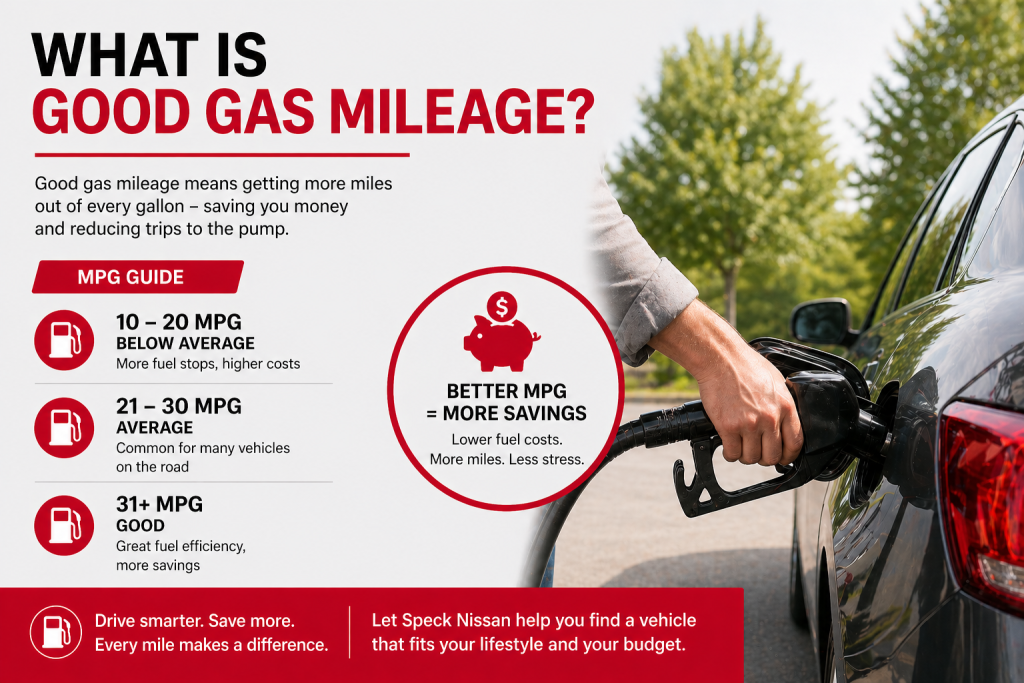
With fuel prices constantly fluctuating, getting good gas mileage has never been more important. But what exactly qualifies as good fuel economy? The answer depends on the type of vehicle you drive and how you use it. At Speck Nissan, we carry a wide range of vehicle that deliver impressive fuel efficiency without sacrificing performance or comfort. What is Considered Good MPG? Generally speaking, anything over 30 MPG combined is considered good fuel economy for most drivers. For sedans and compact cars, 35 MPG or higher is excellent. For SUVs and crossovers, hitting 30 MPG or above puts you well ahead of the class average. Trucks and larger vehicle naturally delivered lower numbers, but modern engineering has brought even those figures up significantly in recent years. The EPA rates every new vehicle for city, highway, and combined fuel economy, and those numbers are a great starting point when comparing your options. City vs. Highway MPG It is important to understand the difference between city and highway fuel economy. City MPG reflects driving with frequent stops and slower speeds, which generally burns more fuel. Highway MPG reflects steady cruising at higher speeds, which typically where vehicles shine in terms of efficiency. Most drivers experienced a blend of both, which is why the combined rating is often the most useful numbers when shopping for a fuel-efficient vehicle. Nissan Models That Get Over 30 MPG Highway 2026 Nissan Versa Sedan Nissan offers several models that exceed 30 MPG on highway, making them smart choices for commuters and long-distance drivers alike. The Nissan Sentra delivers an impressive EPA-estimated 39 MPG on the highway, making it one of the most fuel-efficient sedans in its class. Now, the Nissan Versa is another standout, earning up to 40 MPG on the highway and serving as one of the most affordable and efficient vehicles available today. The Nissan Altima checks in at an estimated 38 MPG highway, offering a great blend of efficiency and midsize sedan comfort. For SUV shoppers, the Nissan Kicks delivers up to 36 MPG on the highway in a practical and stylish compact crossover package. The Nissan Rogue also impresses with an estimated 33 MPG highway, making it a top choice for families who want efficiency without giving up space. Final Thoughts Good gas mileage starts at around 30 MPG and gets better from there. Nissan's lineup is packed with efficient options that deliver real-world savings on every drive. Visit Speck Nissan today to explore our fuel-efficient models and find the one that fits your lifestyle and budget best. Make sure to see if we have any specials available! Shop Nissan The information provided is for general informational purposes only and does not constitute legal, financial, or professional advice. While we strive to provide accurate and up-to-date information, we make no guarantees regarding the completeness, accuracy, or reliability of the information presented. Any action you take based on the context of this blog is strictly at your own risk. Always consult a qualified professional or specialist for advice specific to your situation. We are not responsible for any losses or damages arising from the use of this blog or its content.

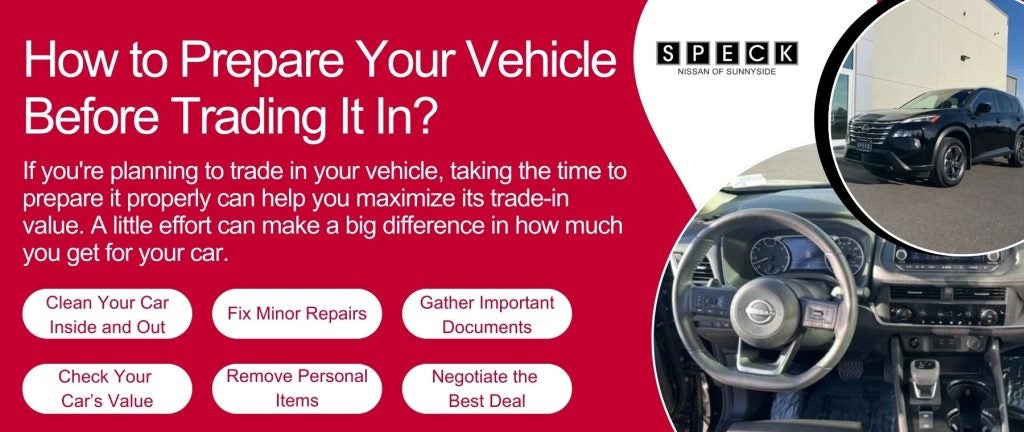
A graphic highlighting the key points of the article and how to prepare for trade in

How to Prepare Your Vehicle Before Trading It In

If you're planning to trade in your vehicle, taking the time to prepare it properly can help you maximize its trade-in value. A little effort can make a big difference in how much you get for your car. Here are some essential steps to take before bringing your vehicle to the dealership. 1. Clean Your Car Inside and Out First impressions matter! A clean car looks well-maintained and can increase its perceived value. Exterior: Wash and wax your car to restore its shine. Interior: Vacuum the carpets, wipe down surfaces, and remove personal belongings. Windows & Mirrors: Clean all glass surfaces to improve visibility and presentation. 2. Fix Minor Repairs Small fixes can go a long way in improving your car's value. Replace burned-out bulbs Fix minor scratches with touch-up paint Check and top off fluids (oil, coolant, windshield washer, etc.) Replace worn wiper blades 3. Gather Important Documents Having all necessary paperwork ready will streamline the trade-in process. Vehicle title (if applicable) Registration and any loan payoff details Service records to show regular maintenance Spare keys and owner's manual 4. Check Your Car's Value Before heading to the dealership, research your car's trade-in value using tools like Kelley Blue Book or Edmunds. This will give you an idea of what to expect and help you negotiate a fair price. 5. Get a Pre-Trade-In Inspection Consider having a mechanic inspect your car to identify any issues that could affect its value. Addressing minor problems beforehand may help you get a better offer. 6. Remove Personal Items Make sure to remove all personal belongings before trading in your car. Check under seats, in storage compartments, and in the trunk to ensure nothing is left behind. 7. Negotiate the Best Deal Once at the dealership, be prepared to negotiate. If you've done your research, you'll have a better understanding of your car's value and can confidently work towards the best possible trade-in offer. Final Thoughts Taking these steps before trading in your vehicle can help you secure that best value and ensure a smooth process. If you're ready to trade in your car, visit our dealership today for a fair appraisal and a great deal on your next vehicle!

Car Emergency Kit and Winter Driving Tips

Winter driving conditions have arrived in Sunnyside and the Yakima area. You never know when you will be in an emergency situation, whether it's from your vehicle breaking down, imminent weather, or the Snoqualmie Pass being closed. Make sure you and your Nissan are prepared with this Car Emergency Kit Checklist: First Aid Kit Jumper Cables Emergency Escape Tool (you can find a variety of tools made to break through tempered glass windows) Road flares and safety flashing warning light Tire repair kit Emergency blankets Gloves Flashlight and/or a wearable personal safety light Nonperishable, high-energy foods, such as unsalted nuts and hard candy Drinking water Fire extinguisher Duct tape Snow brush and shovel Non-clumping cat litter (or sand) for traction Multi-tool Sleeping bag Winter boots Hand warmers Battery or hand-crank powered radio Winter driving tips from your friend at Speck Nissan in Sunnyside, Washington. Watch for black ice. It can be very hard to see, especially at night, but black ice is very slippery and dangerous. If your vehicle gets stuck in the snow and you don't have non-clumping cat litter or sand, you can put your floor mats next to the tires and slowing move your car across them. Make sure to completely clear snow and ice from the windshield. Increase your following distance to at least 10 seconds. Do not use your cruise control during winter driving conditions. If you are broken down, signal for help by tying a bright colored cloth to your vehicle's antenna or put in a rolled up window. Before hitting the road for you winter road trip, come see the service experts at Speck Nissan to make sure your vehicle is running in optimal condition. It is important to get your tires, windshield wipers, lights, coolant, oil and more checked out. Call 509-837-5501 today or schedule your service online. The information provided is for general informational purposes only and does not constitute legal, financial, or professional advice. While we strive to provide accurate and up-to-date information, we make no guarantees regarding the completeness, accuracy, or reliability of the information presented. Any action you take based on the context of this blog is strictly at your own risk. Always consult a qualified professional or specialist for advice specific to your situation. We are not responsible for any losses or damages arising from the use of this blog or its content.